Case study - Yokiko Shiba Inu
From invisible to ranking #1 for shiba inu price - in 90 days.
A new ethical Shiba Inu breeder went from no website, no ABN, and no online presence to 344 top-3 Google rankings on a $3,000 budget.
- Client
- Yokiko Shiba Inu
- Year
- 2025
- Role
- Strategy, design, build, SEO
- Budget
- $3,000
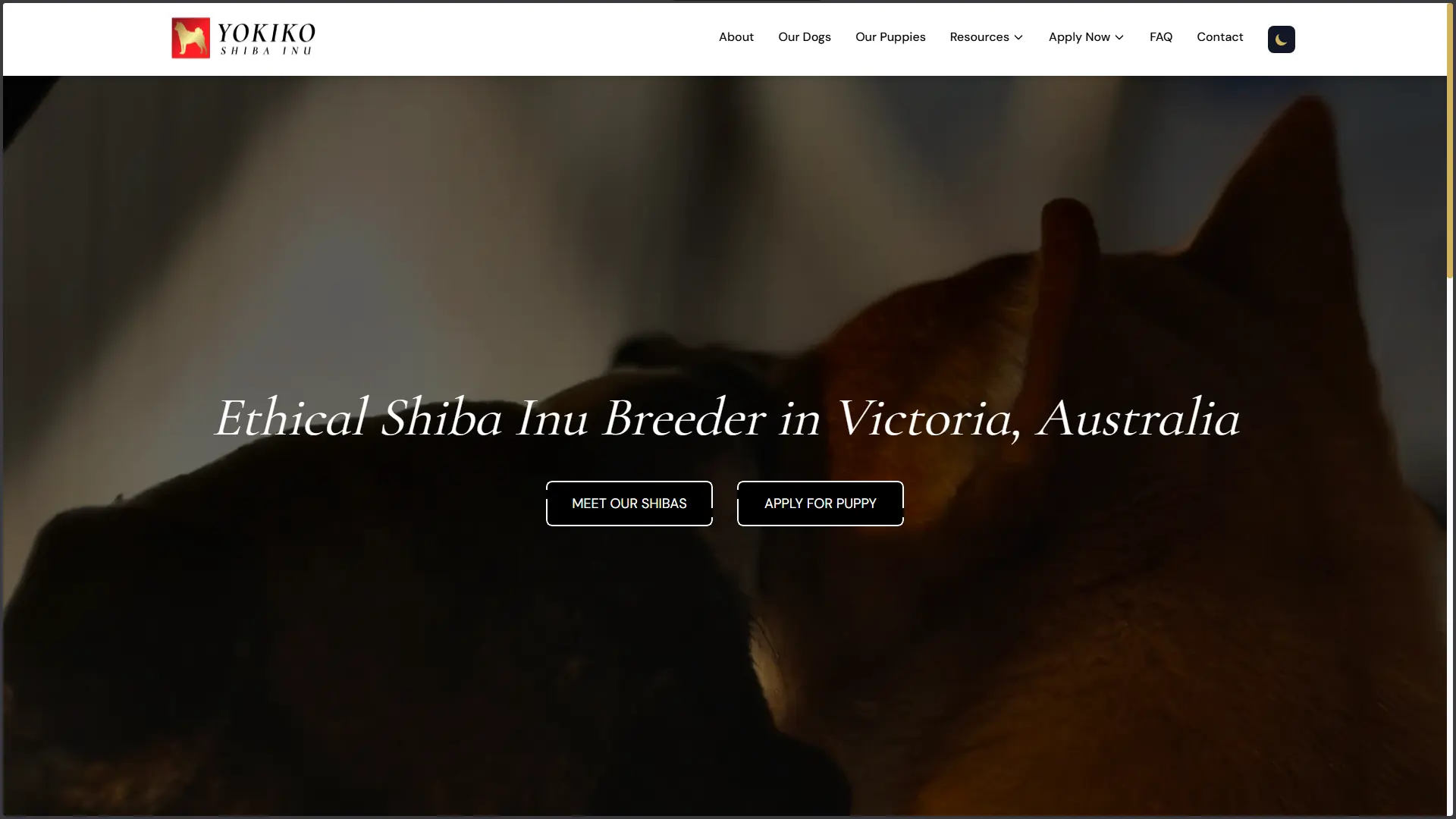
When Yokiko first reached out, they didn’t have a website. They didn’t have an ABN. They didn’t have litters on the ground. What they had was a Shiba Inu they intended to breed and a question: should we actually do this?
Eight months later they’re ranking in the top three Google results for 344 distinct queries, their waitlist for this year is full, next year is filling, and they’re scaling from two litters a year to three.
This is the story of how a $3,000 website became the entire commercial foundation for a new breeding business.
The brief
A breeder, two months out from their first litter, with zero online presence.
A small ethical Shiba Inu breeder, two months out from their first litter. No website, no business identity, no online presence beyond a personal TikTok. Total online discovery: zero.
The decision they were trying to make was bigger than design: was breeding even the right move? So we started before the website - with a positioning exercise, some landing page concepts, and a written online business plan. The bitch went into heat. They committed. The website went live two months out from puppies-ready.
In a market where buying a puppy is a $3,000+ trust decision made by strangers on the internet, the website wasn’t a marketing channel. It was the entire trust signal.
What “no website” actually meant.
For most prospective Shiba Inu buyers in Australia, the user journey before Yokiko launched looked like this:
- Google “shiba inu breeder Melbourne”
- Get a handful of large established kennels, generic directory listings, and Reddit threads
- Either pick one of the established options, or scroll for hours hoping to find someone smaller and more personal
- If they did find a smaller breeder, they had no way to verify legitimacy beyond an Instagram grid
Yokiko was completely absent from that journey. The competitive set was every established Shiba Inu kennel in the country, plus the inertia of “the first result is probably fine.”
The job, then, wasn’t just to build a website. It was to make a brand-new breeder feel as credible as a 20-year-old kennel - and to do it before they had a single review, a single sold puppy, or a single Google result to their name.
Four principles that shaped the whole build.
Trust is structural, not decorative. Pretty design doesn’t make a stranger feel safe handing over $3,000 for a living animal. Structure does - a clear breeder identity, a transparent process, real questions answered, no hard sell. Every section was designed to remove a reason to doubt, not to add a reason to buy.
SEO is a 6-12 month investment that has to start at launch. Most small breeder sites are built once, then never touched. They rank for nothing because they were never built to rank. We built Yokiko’s site with structured metadata, clean URLs, schema markup, and a content hierarchy aligned to search intent - before the first puppy was on the ground, so by the time they had something to sell, Google already knew who they were.
Owner-driven design. It’s their business, their dogs, their voice. My job is UX, SEO, and technical structure; their job is breeder identity, photos, and writing. That partnership produced something that doesn’t look like a template, because it isn’t one.
Custom build, not a template. A Squarespace template would have shipped faster and cost a quarter as much, but it would have produced what every other small breeder has: slow, generic, unrankable. The whole point of the engagement was to notbe that.
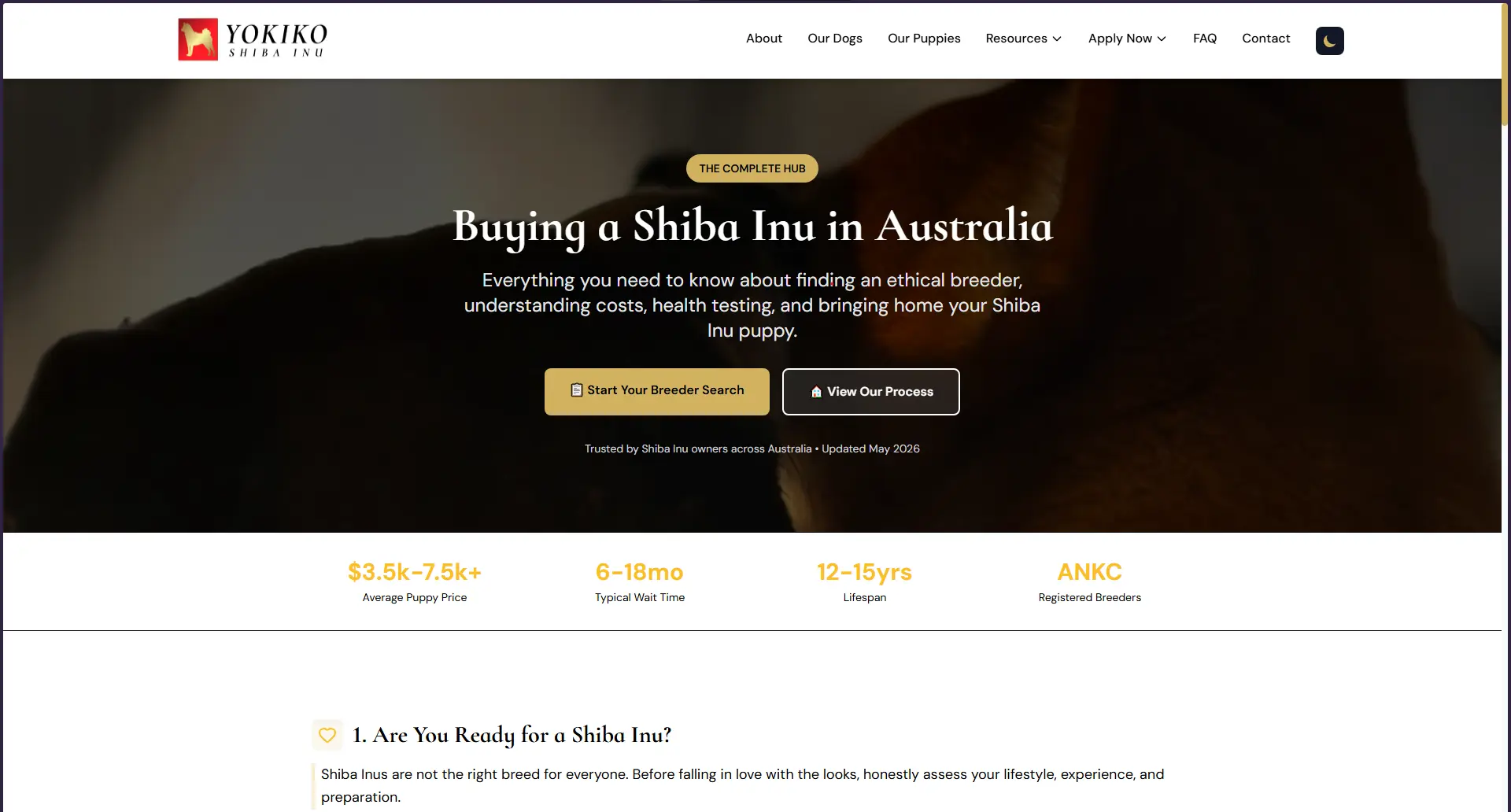
A full custom site, designed and developed from a blank canvas.
Specifically:
- The full site architecture - homepage, breeder story, our dogs, puppy listings, application form, contact, FAQ, blog, resources
- A working puppy application form - wired backend, screening-question structure designed with the breeder so they can pre-qualify enquiries instead of fielding tyre-kickers
- A 21-article content library - four pillar pages plus 17 supporting guides, covering buying, feeding, training, grooming, health, vet care and pricing
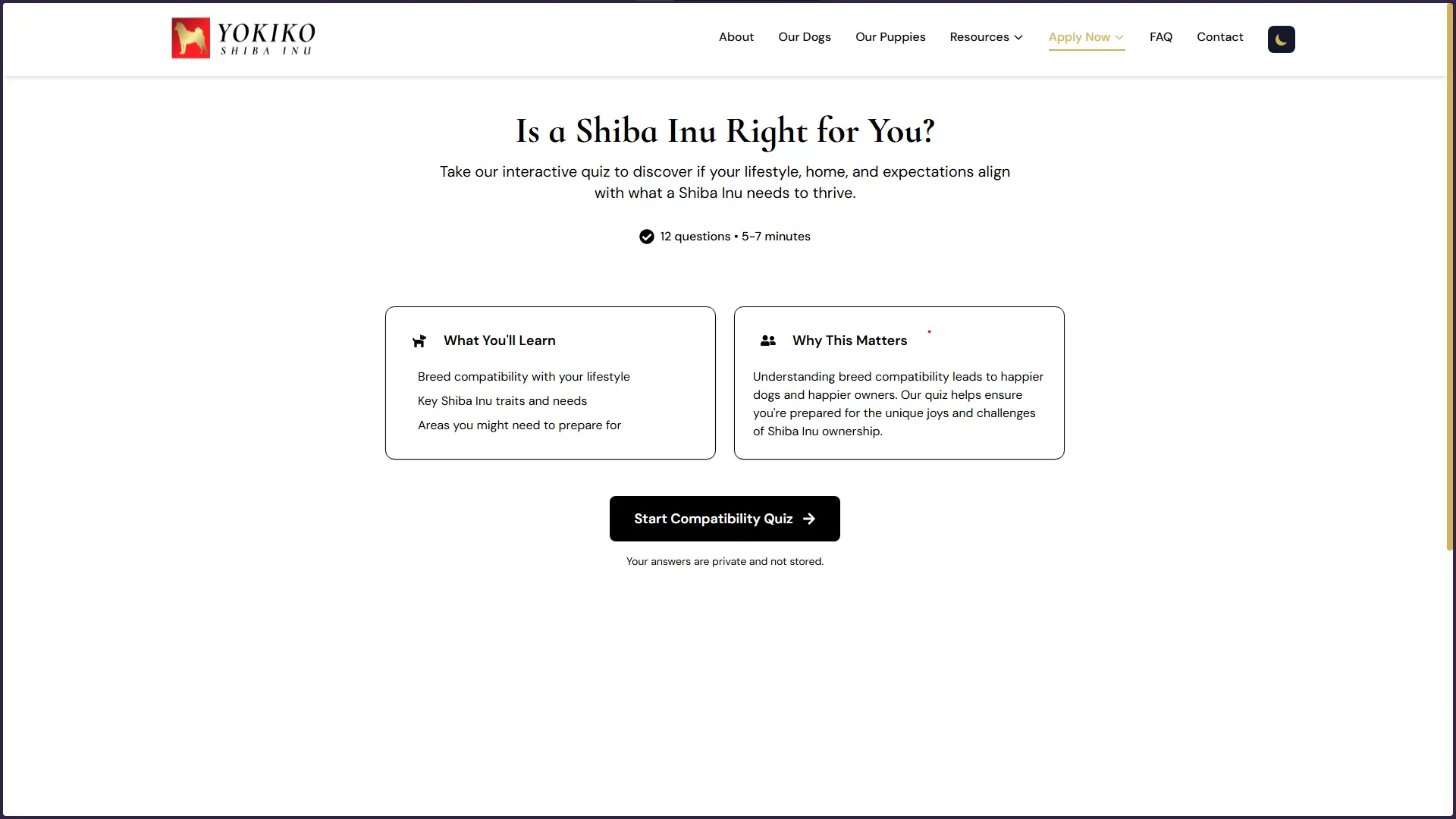
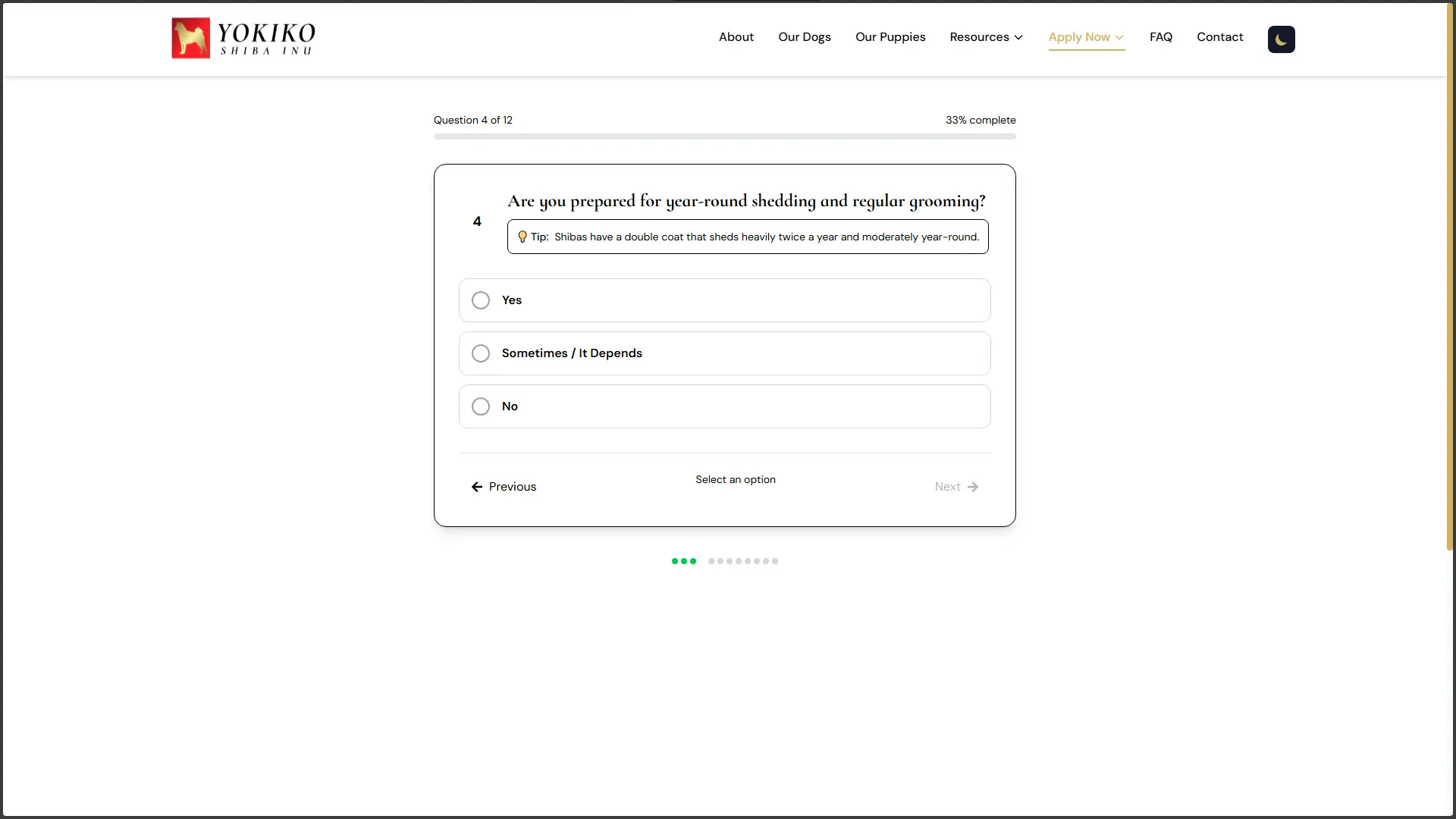
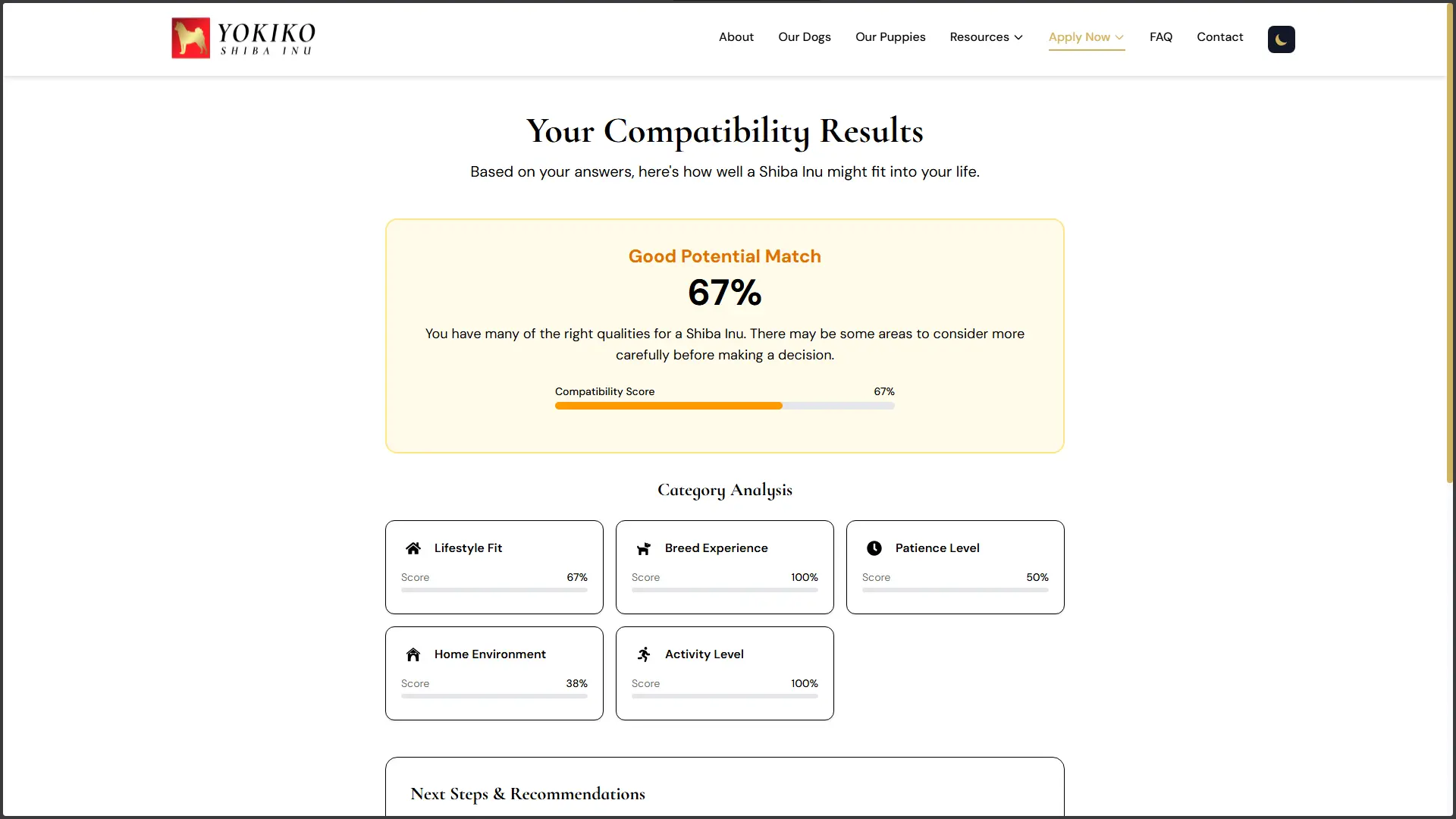
- A Shiba Inu compatibility quiz - interactive tool that helps prospective owners self-qualify before they apply. Sets the tone that this is an ethical breeder, not a sales funnel.
- Full SEO foundations - per-page titles and meta, schema markup, sitemap, canonical URLs, Open Graph
- An ongoing blog workflow - the breeder writes the content (they’re the expert); I review for SEO and target keywords. New posts ship regularly.
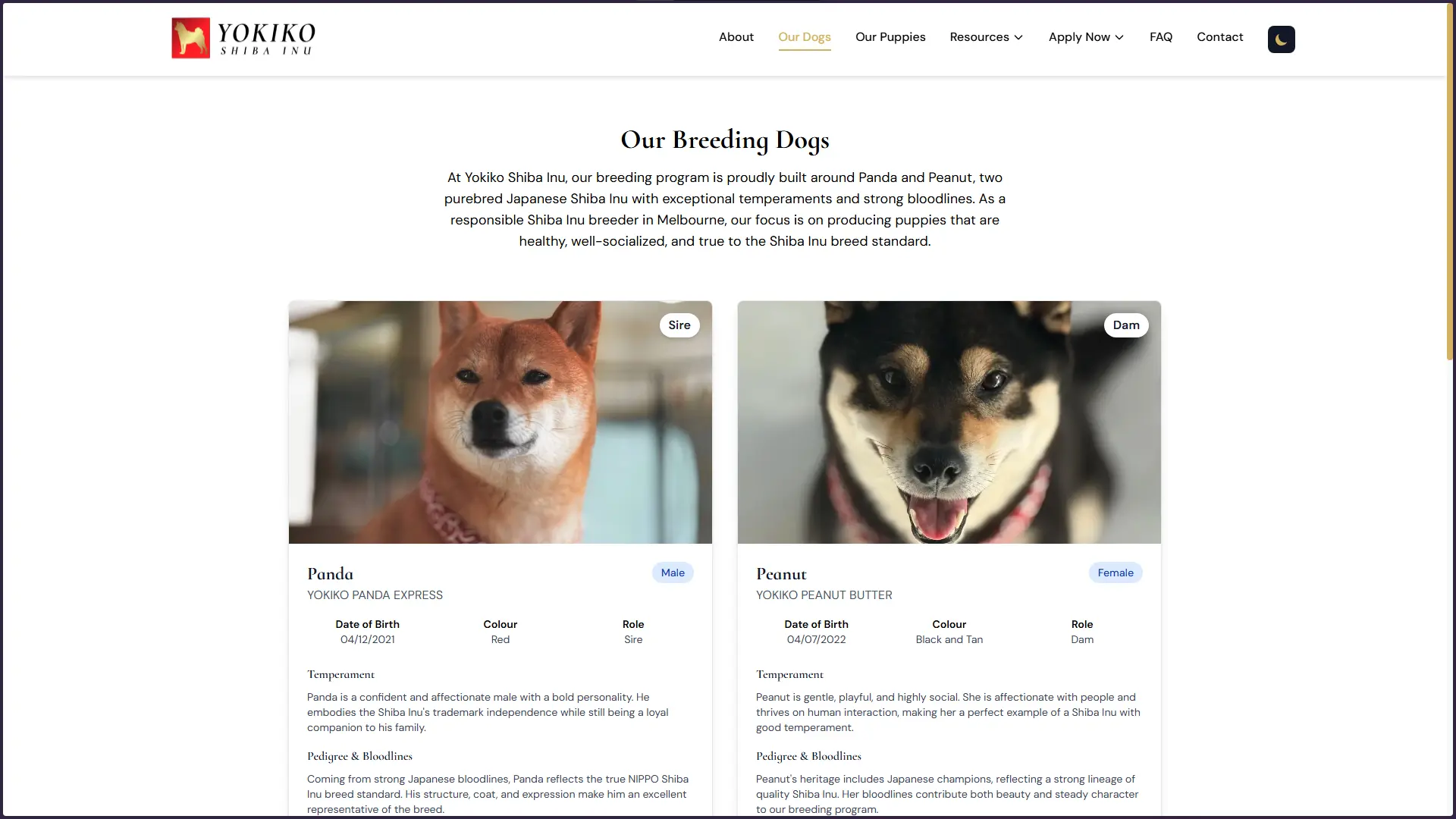
The results
What 90 days of real Google Search Console data looks like.
Google Search Console, rolling 90 days. Snapshot taken at time of publication.
For a brand-new domain in a niche category, this is unusually strong. A few of the rankings worth pointing at specifically:
| Search term | Position | What it means |
|---|---|---|
| shiba inu breeders victoria | #1.9 | We own this term in their actual market |
| shiba inu price | #1.1 | They rank above every other Shiba Inu site in Australia for the most-asked Shiba question |
| shiba inu price puppy | #2.4 | Same cluster - top 3 for a high-intent buyer query |
| shiba inu breeder melbourne | #4.4 | Page 1, with a 21.4% click-through rate |
| shiba inu puppy for sale melbourne | #5.6 | Page 1 for the most direct purchase-intent query |
| shiba inu cost australia | #2.6 | Owning the pricing-question niche cluster |
| how often to bathe shiba inu | #3.6 | Proves the supporting-guide content strategy is working |
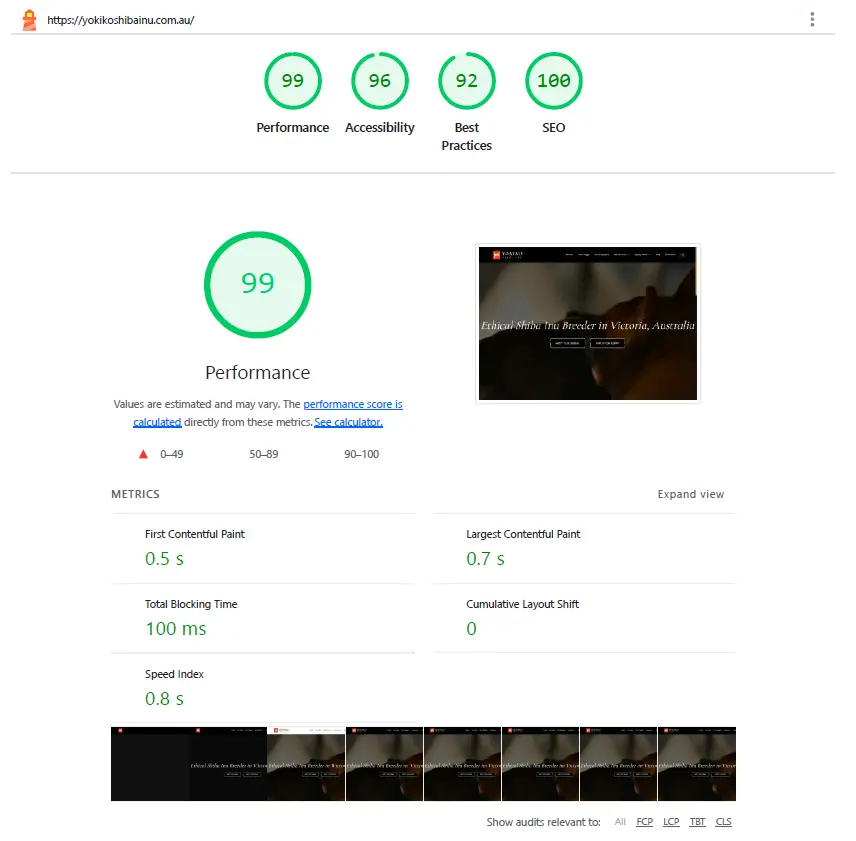
Fast on desktop - and, after a refactor, fast on mobile too.
Desktop Lighthouse (homepage): Performance 100, Accessibility 96, Best Practices 92, SEO 100.
Mobile Lighthouse (homepage): Performance 98, Accessibility 96, Best Practices 88, SEO 100.
Real-world Core Web Vitals on mobile: Largest Contentful Paint 2.3 s (well inside Google’s threshold), Cumulative Layout Shift 0 (perfect), First Contentful Paint 1.6 s, Total Blocking Time 10 ms.
The feature I’m most proud of
The compatibility quiz.
A 6-question interactive flow that helps a prospective owner figure out whether a Shiba Inu actually suits their lifestyle. It exists because Shibas are famously not easy dogs - they’re independent, vocal, shedding-heavy, and not for everyone.
The quiz does three jobs at once:
- Filters bad-fit enquiries before they happen - an honest “you may want to consider another breed” outcome saves the breeder hours of polite rejection emails
- Builds trust through honesty - a breeder who actively tries to talk you out of buying their puppies reads as ethical, not desperate
- Drives engagement - quiz-takers spend 2-4 minutes on site and submit more genuine applications
It’s a small feature with outsized strategic value, and it’s the kind of thing a Squarespace template could never have built - and, after the refactor above, it costs nothing on mobile load.
What it cost, and why it was worth it.
This work was delivered for $3,000.
To put that in market context:
- Squarespace template + DIY: ~$500/year, visually generic, no SEO foundation. Yokiko wouldn’t be ranking for anything.
- Digital agency: $8,000-$15,000 for the same scope. Most of that cost is overhead, not deliverable.
- Freelance dev with no design or SEO involvement: $2,000-$4,000. Would have shipped a site that loads fast and looks fine and ranks for nothing.
The $3,000 figure reflects what this actually is: a senior-quality custom build from someone who handles design, development, SEO and ongoing strategy in one engagement. Mid-market pricing, agency-quality output, owner-direct relationship.
For a breeder selling puppies in the $3,000-$4,500 range, the entire website cost less than a single puppy. The waitlist it filled covers it many times over.
“We came to Nelson with a naive idea and he came back with a strategy that took every concern off the table. We’re really happy with the outcome and can’t wait to keep working with him as we expand.”
Honest reflections
Two things worth flagging rather than skipping over.
What we re-did
We originally built the blog as MDX (a Markdown variant that lets you embed React components in articles). It’s the technically prettier choice. In practice, getting the layouts consistent across 21 articles became a friction point, and we re-platformed the blog onto a JSON-driven structure that’s faster to author and edit. The client gets to update content without touching any code; that mattered more than the technical purity of MDX.
The design back-and-forth
Mid-build, we had several conversations where the client pushed back on UX or copy choices. Most of those conversations ended with them right on tone and me right on SEO - so the final wording often threaded both. A useful reminder that the best result usually isn’t either party’s first instinct.
What I’d do differently
Honestly, very little. The hardest thing about this engagement was being patient enough to let an SEO strategy compound - three months in, we had 200-odd impressions a day and the client was understandably anxious; at six months it was 600+. Pre-warning clients about the SEO J-curve is something I now do more explicitly upfront. On the technical side, the one thing I’d carry forward is budgeting for a mobile-performance pass at launch rather than as a follow-up - the 72-to-98 refactor was worth doing, but it could have been built in from day one.
The build is complete. The compounding has begun.
Yokiko is now on a monthly SEO retainer - keeping the top-3 rankings, publishing 1-2 new guides per month, monitoring Search Console for new query opportunities, and tightening pages sitting at position 4-8 to push them onto page 1.
The waitlist for this year’s litter is full. Next year is filling. They’re planning a third dog and a third litter for next year. The website went from a thing they didn’t have to the commercial backbone of an entire small business.
Why this matters
For any small animal business making the same mistake.
The patterns that played out here aren’t Shiba-specific. They apply to any small animal business - breeders, mobile vets, groomers, trainers, boarding kennels - that depends on stranger-trust at the start of the buying journey.
Most of those businesses currently sit on:
- Outdated websites built once and abandoned
- No SEO structure, so they exist online but aren’t findable
- Unclear messaging that doesn’t address the real anxieties of buyers
- Enquiry systems that lose leads silently
Yokiko shows what the alternative looks like when you treat the website as the commercial foundation rather than a brochure: structured for search, designed for trust, built to compound over time.
If you run a small animal business and any of this rings true, get in touch - this is the work I do.